
Business travel by air is one of the largest contributors to a company's Scope 3 carbon footprint. A single return transatlantic flight generates 1–2 tonnes of CO₂ per passenger — and for organisations managing hundreds or thousands of trips per year, this adds up fast. Carbon offsetting flights gives corporate travel managers, TMCs, and travel agencies a practical tool to compensate for unavoidable flight emissions by investing in verified carbon reduction and removal projects.
With the EU's CSRD now requiring Scope 3 emissions reporting and CORSIA tightening aviation offset rules from 2027, understanding how flight carbon offsetting works is no longer optional — it's a business imperative.
This guide covers how carbon offsets for flights work, which project types and quality standards to look for, and how to choose a provider that meets the bar for corporate sustainability programmes.
Making Sustainable Choices: Conscious Choices as a Traveller
Carbon offsetting is most credible when it sits within a broader reduction strategy. The hierarchy is clear: avoid unnecessary flights, reduce the impact of essential flights, then offset the remainder with high-quality credits. For a comprehensive overview of all reduction levers, see our full guide to reducing and offsetting business travel emissions.
Avoid
Not every meeting requires a flight. Video conferencing, hybrid events, and regional hub strategies can eliminate a significant portion of corporate air travel without compromising business outcomes. Many companies that scrutinised their travel patterns during the pandemic found that 30–40% of pre-COVID flights were not essential.
Reduce
When flying is necessary, the emissions per trip can be reduced through practical choices:
Choose direct flights. Connections add takeoff and landing cycles, which are the most fuel-intensive phases of flight. A direct route almost always has a lower carbon footprint than a connecting itinerary.
Fly economy. Business class generates 2.5–3x the emissions of economy per passenger due to seat space allocation. For companies serious about Scope 3 reduction, travel class policy is a high-impact lever.
Prefer fuel-efficient airlines. Fleet age and aircraft type matter. Airlines operating newer-generation aircraft (A320neo, 787, A350) deliver measurably lower per-seat emissions.
Switch to rail where practical. For journeys under 700 km, high-speed rail produces roughly 95% less CO₂ than flying. On routes like Amsterdam–Paris, London–Brussels, or Munich–Vienna, rail is often competitive on total journey time once airport procedures are factored in.
Offset the Remainder
After reduction measures are applied, a residual emission footprint will remain for any organisation that needs people to travel by air. This is where high-quality carbon offsetting becomes essential. The goal is not to use offsets as a licence to fly without limits, but to take financial responsibility for unavoidable emissions while funding projects that deliver measurable climate benefit.
This approach aligns with the SBTi's Beyond Value Chain Mitigation (BVCM) guidance, the Oxford Principles for Net Zero Aligned Carbon Offsetting, and the VCMI Claims Code.
The Role of the Airline Industry in Global CO2 Emissions
The airline industry currently contributes 2-3% to global CO2 emissions. This percentage may seem modest at first glance, but the impact is growing rapidly due to the increasing demand for air travel.
A comparison of different modes of transport shows how intensive flying is in terms of CO2 emissions:
Airplane: 285g CO2 per passenger per kilometer
Car (1 person): 192g CO2 per kilometer
Train: 14g CO2 per passenger per kilometer
Bus: 68g CO2 per passenger per kilometer
"A return economy-class flight from Amsterdam to New York generates approximately 1.5 tonnes of CO₂ per passenger — equivalent to roughly 8% of the average European's annual carbon footprint."
The Growing Impact of Aviation on the Climate The growing impact of aviation on the climate is exacerbated by various factors. Emissions at high altitudes have a stronger greenhouse effect, and the number of flights increases annually by an average of 5%. Unfortunately, technological improvements cannot currently keep up with the growth in emissions.
The aviation industry faces a major challenge: the sector must innovate to reduce CO2 emissions while the demand for air travel continues to rise. New technologies such as electric aircraft and sustainable fuels offer potential, but are still in the development phase.
How Does Carbon Offsetting Work for Air Travel?
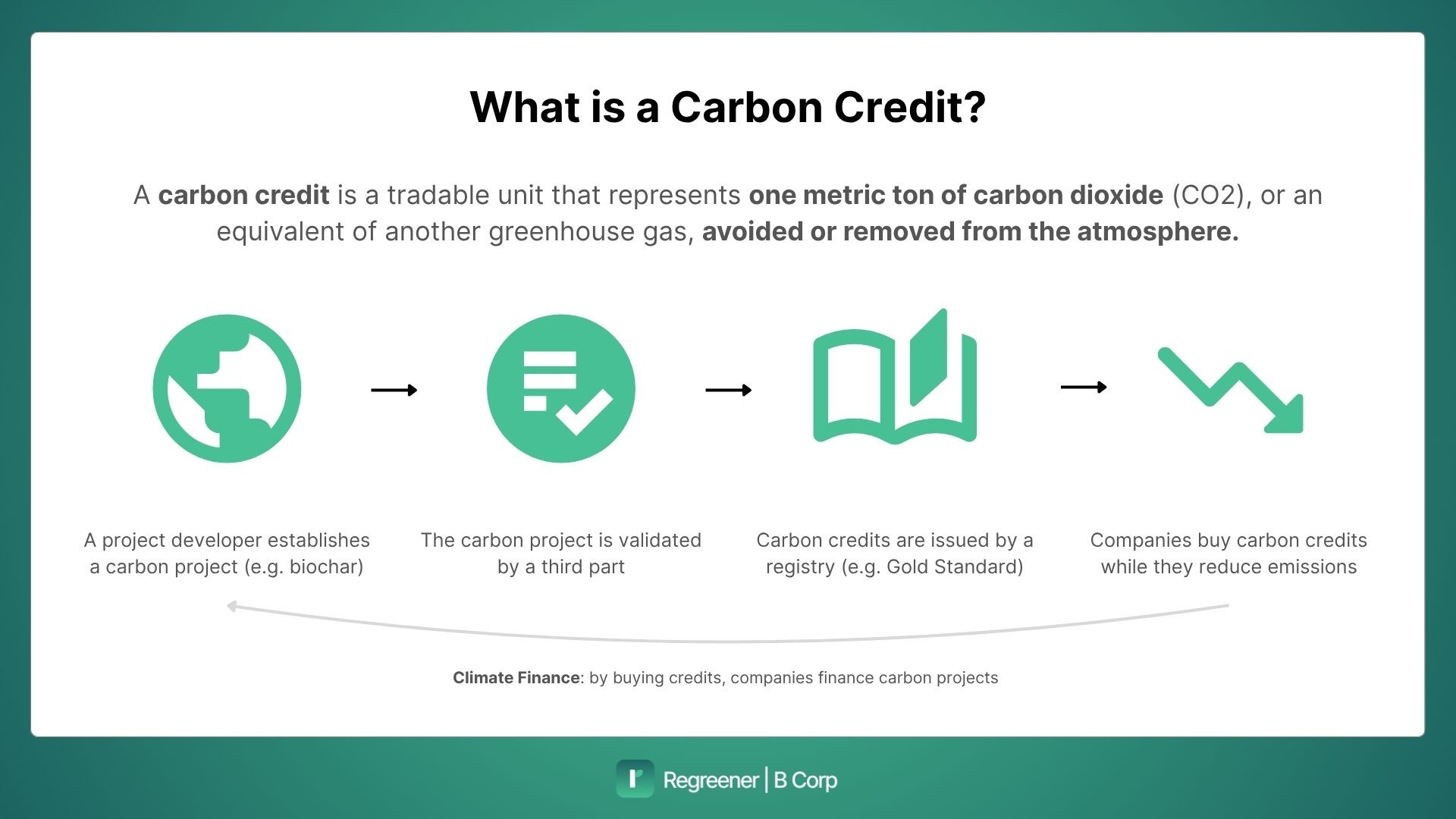
Carbon offsetting for flights is the practice of compensating for the CO₂ emissions produced by air travel by purchasing verified carbon credits from projects that reduce or remove greenhouse gases elsewhere. One carbon credit represents one tonne of CO₂ equivalent (tCO₂e) that has been avoided or removed from the atmosphere.
For businesses, the process typically works at programme level rather than per individual ticket. A company or its TMC calculates the total CO₂ emissions from all business flights over a defined period — usually quarterly or annually. Those emissions are then matched with an equivalent volume of carbon credits from a curated portfolio of verified projects. Once purchased, the credits are permanently retired in the relevant registry (Verra, Gold Standard, or another recognised standard), ensuring they cannot be resold or double-counted.
The cost of offsetting depends on the type of carbon credits selected. Market prices currently range from €5 to €30 per tonne of CO₂ for standard avoidance credits (such as renewable energy or cookstove projects), and from €30 to €150+ for high-permanence removal credits (such as biochar or direct air capture). For context: offsetting a return economy flight from Amsterdam to New York — approximately 1.5 tonnes of CO₂ — costs between €8 and €45 depending on credit quality.
The key distinction to understand is that offsetting does not eliminate the emissions from the flight itself. It compensates for them by ensuring an equivalent reduction or removal happens elsewhere. That is why best practice, aligned with the Oxford Principles for Net Zero and SBTi guidance, is always to reduce emissions first and offset the remainder.
How TMCs and Travel Agencies Can Integrate Flight Offsetting Into Their Services
For Travel Management Companies and travel agencies, carbon offsetting is not just a sustainability add-on — it is a strategic service that drives client retention, supports RFP competitiveness, and opens a new margin-positive revenue line.
Embedding Offsets in the Booking Flow
The most seamless approach is to integrate emission calculation and offset pricing directly into the booking platform. When a travel arranger or self-booking traveller selects a flight, the associated CO₂ emissions and offset cost are displayed alongside the ticket price. This can be configured as opt-in (traveller chooses to add the offset) or programme-default (offset is automatically applied and billed to the corporate account).
Programme-Level vs. Per-Trip Offsetting
Some corporate clients prefer per-trip offsetting for maximum transparency and traveller engagement. Others prefer programme-level offsetting, where total emissions are calculated and offset quarterly or annually. Programme-level offsetting is operationally simpler and often more cost-effective, as credits can be procured in bulk at negotiated rates.
White-Label and API Solutions
Providers like Regreener offer white-label solutions that allow TMCs and travel agencies to present carbon offsetting under their own brand, while Regreener handles credit procurement, project curation, and retirement documentation behind the scenes. API integration enables automated emission calculation, credit allocation, and per-client reporting without manual intervention.
Client Reporting and Scope 3 Data
One of the highest-value services a TMC can offer is structured emission reporting that feeds directly into a client's CSRD or GHG Protocol Scope 3 disclosure. This means: CO₂ per trip, per traveller, per route, per business unit — broken down by transport mode, travel class, and offset status. When the offset provider delivers retirement certificates linked to specific projects, the client has an auditable trail from booking to credit retirement.
The Business Case for TMCs
TMCs that can demonstrate integrated sustainability capabilities win more bids. In an era where RFPs routinely include sustainability scoring criteria, the ability to say "we provide real-time emission tracking, curated offset portfolios, and CSRD-ready Scope 3 reporting" is a meaningful competitive edge. The margin on offset procurement, while modest per transaction, compounds across a large client portfolio.
How to Calculate Carbon Emissions from Business Flights
Accurate emission calculation is the foundation of any credible offset programme. Here is how it works.
Emission Factors
Flight emissions are calculated using emission factors expressed in kg CO₂ per passenger-kilometre. These factors vary by:
Flight distance: Short-haul flights have higher per-km emissions due to the energy-intensive takeoff and landing phases. Long-haul flights are more fuel-efficient per km at cruising altitude.
Aircraft type: Newer, more fuel-efficient aircraft (e.g., Airbus A350, Boeing 787) produce significantly lower emissions per seat-km than older models.
Occupancy rate: A fuller plane means lower per-passenger emissions. Most calculators use average load factors by route.
Travel Class Multipliers
Business and first-class seats take up significantly more cabin space than economy seats, meaning each passenger in a premium cabin is allocated a larger share of the aircraft's total emissions. Standard multipliers are approximately:
Economy: 1x (baseline)
Premium Economy: 1.5x
Business Class: 2.5–3x
First Class: 4x
For companies with heavy business-class travel, these multipliers make a substantial difference to total programme emissions and offset costs.
Practical Approach
For corporate programmes, the most pragmatic approach is to use a recognised emission calculation methodology and apply it consistently across all business flights. Regreener provides automated emission calculation for corporate clients, using route-level data, class-adjusted factors, and optional RFI inclusion.
CORSIA Explained: What the Aviation Carbon Offset Scheme Means for Your Travel Programme
The Carbon Offsetting and Reduction Scheme for International Aviation (CORSIA) is a global market-based mechanism developed by ICAO to stabilise net CO₂ emissions from international aviation. While CORSIA directly regulates airlines rather than corporate buyers, it has significant implications for businesses, TMCs, and travel agencies.
How CORSIA Works
Under CORSIA, airlines with annual international flight emissions above 10,000 tonnes of CO₂ must monitor, report, and verify their emissions. When those emissions exceed a defined baseline (set at 85% of 2019 levels for 2024–2035), airlines must offset the excess by purchasing and retiring eligible emissions units (EEUs) from approved carbon credit programmes.
CORSIA Timeline
CORSIA has been rolled out in phases. From 2021 through 2026, only flights between voluntarily participating states are subject to offsetting requirements. From 2027, the scheme becomes mandatory for virtually all international flights, with limited exemptions for routes involving Least Developed Countries, Small Island Developing States, and states with very small shares of international air traffic.
"Under CORSIA, all international flights will be subject to mandatory carbon offsetting requirements from 2027, with airlines needing to offset emissions exceeding 85% of their 2019 baseline."
What This Means for Corporate Travel
Although CORSIA obligations fall on airlines, the costs will inevitably flow through to ticket prices. More importantly, CORSIA is accelerating demand for high-quality carbon credits in the aviation sector, which affects pricing and availability for voluntary corporate offsetting programmes. Companies that establish offset procurement relationships now will be better positioned as the market tightens.
For TMCs, understanding CORSIA is essential for advising corporate clients on their total exposure: airline-level CORSIA compliance covers part of the picture, but voluntary corporate offsetting on top of that demonstrates genuine climate leadership and addresses Scope 3 reporting obligations that CORSIA alone does not fulfil. The IATA voluntary carbon offsetting best practices page provides additional background on how the airline industry is implementing the scheme.
Within the EU, intra-EEA flights are already covered by the EU Emissions Trading System (EU ETS), which operates separately from CORSIA. Corporate buyers should understand that emissions from flights within Europe are priced under ETS, while intercontinental routes fall under CORSIA — there is no double regulation on the same route.
Types of Carbon Offset Projects for Aviation Emissions
Carbon credits used to offset flight emissions come from a wide range of project types. Understanding the differences is essential for building a credible offset portfolio.
Nature-Based Solutions
Nature-based projects leverage ecosystems to absorb or avoid CO₂ emissions. Common types include:
REDD+ (Reducing Emissions from Deforestation and Forest Degradation): These projects protect existing forests that would otherwise be logged or cleared. They are among the most widely traded credit types but require careful due diligence on baseline assumptions and leakage risk.
Reforestation and Afforestation (ARR): Tree planting projects that create new carbon sinks. These generate removal credits but take years to deliver their full sequestration potential, so permanence and buffer pool provisions are important quality indicators.
Mangrove and Peatland Restoration: Coastal and wetland ecosystems store carbon at rates significantly higher than terrestrial forests per hectare. These projects also deliver strong biodiversity and coastal protection co-benefits.
"💡 Expert Tip: Look for carbon credits with an ICVCM Core Carbon Principles (CCP) label. CCP-labelled credits have passed the market's toughest integrity assessment and are fast becoming the standard for corporate procurement."
Bernard de Wit, Founder
Engineered Carbon Removal
Engineered removal projects use technology to capture CO₂ directly from the atmosphere or lock carbon into stable, long-duration storage:
Biochar: Biomass is converted into stable carbon through pyrolysis and applied to agricultural soils, where it remains sequestered for hundreds to thousands of years. Biochar credits are gaining traction for their high permanence and verifiable MRV.
Direct Air Capture (DAC): Industrial facilities capture CO₂ directly from ambient air and store it geologically or in durable products. DAC credits are the highest-permanence option available but currently cost €200–€600+ per tonne.
Enhanced Rock Weathering (ERW): Crushed silicate minerals are spread on agricultural land to accelerate natural carbon mineralisation. ERW is an emerging category with promising scalability.
Avoidance Projects
Avoidance projects reduce emissions that would otherwise have occurred:
Renewable Energy: Wind, solar, and hydropower projects in regions where they displace fossil fuel generation. These are the most affordable credit type but are increasingly scrutinised on additionality grounds in markets where renewables are already commercially viable.
Clean Cookstoves: Distribution of efficient cooking appliances in developing regions, reducing biomass burning and associated emissions. Strong co-benefits for health, gender equity, and local air quality.
Methane Capture: Landfill gas capture, coal mine methane, and oil well plugging projects that prevent potent greenhouse gases from entering the atmosphere.
Benefits, and Limitations of Carbon Offsetting for Flights
Benefits
Immediate climate impact. Unlike long-term decarbonisation investments, carbon credits fund projects that are reducing or removing emissions today.
Scope 3 management. For companies reporting under CSRD or voluntarily following the GHG Protocol, offsetting provides a structured way to address business travel emissions.
Client and stakeholder expectations. Increasingly, corporate clients, investors, and employees expect companies to take responsibility for their travel footprint. A well-structured offset programme demonstrates climate leadership.
Co-benefits. High-quality offset projects deliver social and environmental co-benefits beyond carbon: biodiversity protection, clean water access, community livelihoods, improved air quality. See Regreener's client success stories for examples of how European businesses build co-benefit value into their offset programmes.
TMC and travel agency differentiation. Offering integrated offsetting creates a tangible sustainability value-add that supports client retention and new business development.
"As a B Corp-certified company, Regreener is independently audited on its social and environmental impact. Regreener evaluates every carbon credit project across 100+ datapoints spanning additionality, permanence, co-benefits, MRV quality, and regulatory compliance."
Limitations
Offsets do not eliminate emissions. The CO₂ from the flight still enters the atmosphere. Offsetting compensates elsewhere — it is not the same as not emitting.
Quality variation. The voluntary carbon market includes credits of widely varying integrity. Without robust due diligence, companies risk purchasing credits that do not deliver their claimed impact.
Time lag. Some project types (notably reforestation) take years or decades to deliver their full sequestration. The emission happens now; the compensation happens over time.
Greenwashing risk. If offsetting is used as a substitute for genuine reduction efforts, it can backfire reputationally. Stakeholders are increasingly sophisticated in distinguishing credible climate strategies from offset-heavy greenwash.
The answer is not to avoid offsetting, but to do it well — with high-quality credits, within a reduction-first framework, and with transparent reporting.